
Summary: Provisional income is adjusted gross income (excluding Social Security), plus tax-exempt interest, plus half of the year’s Social Security benefits. When it exceeds $25,000 (single) or $32,000 (married filing jointly), up to 50% of benefits become taxable; above $34,000 or $44,000, up to 85%. Those thresholds have never been adjusted for inflation, and the 2025 senior deduction did not change any part of this formula.
Since July 2025, advisors have been fielding a new version of an old question. A client heard that the One Big Beautiful Bill Act (OBBBA) ended taxes on Social Security, and they want to know why their projection still shows $34,000 of their benefit as taxable income. The confusion is understandable. The Social Security Administration itself emailed beneficiaries that the new law “eliminates federal income taxes on Social Security benefits for most beneficiaries,” a claim it later corrected on its website. The law did no such thing.
What actually determines how much of a Social Security benefit is taxed is a number most retirees have never heard of: “provisional income.” This guide covers the provisional income formula, the thresholds, the exact math at every tier, what the 2025 law did and did not change, and how advisors sequence withdrawals around it. This article is the technical reference. For a guide on how to talk with clients about Social Security, see our companion guide on explaining Social Security taxes to clients.
What is provisional income?
Provisional income is the measure the Internal Revenue Service (IRS) uses to decide how much of a Social Security benefit is subject to federal income tax. The formula, set by Section 86 of the Internal Revenue Code, has three parts:
Provisional income = adjusted gross income (excluding Social Security) + tax-exempt interest + 50% of Social Security benefits
Each piece deserves a careful look:
- Adjusted gross income (AGI), excluding Social Security. The client’s AGI computed without any Social Security benefits in it: traditional IRA and 401(k) withdrawals, pension income, wages, interest, dividends, capital gains, rental income, and the taxable portion of annuity payments. Social Security is left out of this base to prevent double-counting, because the benefit enters the formula separately in the third term.
- Tax-exempt interest. Municipal bond interest is added back. This surprises clients more than any other line in the formula: interest that is exempt from federal income tax still counts, dollar for dollar, in the test that determines whether their Social Security is taxed.
- Half of the year’s Social Security benefits. Fifty percent of the household’s total benefits for the year, including retirement, spousal, and survivor benefits. Social Security Disability Insurance (SSDI) benefits run through this same formula, while Supplemental Security Income (SSI) payments are never taxable and never enter it, per the IRS FAQ on disability benefits.
The Social Security Administration uses the plainer label “combined income” for the same number. The terms are interchangeable; “provisional income” is the one used in tax research, and “combined income” is the one clients encounter on government websites. IRS Publication 915 walks through the computation line by line.
Do other deductions count?
In determining provisional (“combined”) income, some deductions do count. Specifically, the following deductions reduce provisional income dollar for dollar:
- Deductible traditional IRA contributions
- HSA deductions
- Deductible half of self-employment tax
- Self-employed SEP, SIMPLE, and qualified-plan contributions
- Self-employed health-insurance deductions
- Educator expenses
- Penalty for early withdrawal of savings
- Qualifying alimony paid
- Archer MSA deductions
- Most Schedule 1 “other adjustments”
Many of these are less likely to be present for those receiving Social Security retirement benefits, but in some cases this could tip the scale in favor of certain kinds of retirement account contributions.
What 0%, 50%, and 85% taxability mean
If you’re learning about the taxation of Social Security, you’ll often see reference to 50% or 85% of benefits being taxable. This can be confusing if you’re used to thinking about tax rates. These numbers are not tax rates. They are amounts of benefits that can be taxable. When the tax code says “up to 85% of benefits are taxable,” it means up to 85% of the benefit is included in taxable income, where it is then taxed at the client’s ordinary rate. It has never meant an 85% tax on benefits. A client in the 22% bracket with the maximum 85% inclusion pays at most 18.7 cents of federal tax per benefit dollar, and most retirees pay far less.
It’s also worth noting that these taxability amounts are not flat. They are caps or plateaus of taxability. In practice, something less than 50%, or something between 50% and 85% of benefits might be included in taxable income. We’ll see examples of this below.
The thresholds: $25,000, $32,000, $34,000, and $44,000
Two sets of fixed dollar thresholds determine which tier a household lands in. The base amounts ($25,000 single, $32,000 joint) mark where benefits first become taxable, and the upper thresholds ($34,000 and $44,000) mark where the 85% tier begins. Congress set the first pair in the 1983 Social Security Amendments, effective 1984, and added the second pair in the Omnibus Budget Reconciliation Act of 1993, effective 1994.
| Filing status | Base amount (50% tier begins) | Upper threshold (85% tier begins) |
|---|---|---|
| Single filers, heads of household, qualifying surviving spouses | $25,000 | $34,000 |
| Married couples filing jointly | $32,000 | $44,000 |
| Married taxpayers filing separate returns, lived apart from spouse all year | $25,000 | $34,000 |
| Married taxpayers filing separate returns, lived with spouse at any point | $0 | $0 |
That last row is a genuine trap. A married person who files a separate return and lived with their spouse at any time during the year has a base amount of zero, which means up to 85% of their benefit is taxable even with no other income at all, because half the benefit itself counts toward the test.
The most consequential fact about these thresholds is what they do not do: they never move. Unlike tax bracket thresholds, standard deductions, and the income-based Medicare premium thresholds (IRMAA), which adjust for inflation each year, the provisional income thresholds are fixed in nominal dollars and have not changed since 1984 and 1994 respectively. Congress has never indexed them. The result is a slow-motion expansion of the tax. According to the Social Security Administration’s Issue Paper No. 2015-02 by Patrick Purcell, fewer than 10% of beneficiaries paid federal income tax on their benefits in 1984; the agency’s MINT model projected 52% of beneficiary families would pay it by 2015, rising to 58% by 2030. Every cost-of-living adjustment (COLA) pushes more households across lines drawn four decades ago.
Advisor takeaway: The Social Security taxability thresholds are frozen, but your clients’ incomes are not. A household that owed nothing on benefits three years ago can cross the base amount on nothing more than COLA increases and required minimum distributions. Screening your full client base against the thresholds is an annual exercise, not a one-time check.
The three tiers: how much of a benefit becomes taxable
Provisional income sorts every household into one of three tiers: 0%, up to 50%, or up to 85% of benefits included in taxable income. The words “up to” are doing real work in that sentence, because inside each tier the actual amount is set by a lesser-of computation, from the worksheet in IRS Publication 915, that usually lands below the cap.
| Provisional income (single) | Provisional income (joint) | Maximum share of benefits taxable | The computation |
|---|---|---|---|
| $25,000 or less | $32,000 or less | 0% | No benefits are taxable |
| $25,001 to $34,000 | $32,001 to $44,000 | 50% | Lesser of: 50% of benefits, or 50% of the excess over the base amount |
| Above $34,000 | Above $44,000 | 85% | Lesser of: 85% of benefits, or 85% of the excess over the upper threshold plus the smaller of the 50%-tier amount or $4,500 ($6,000 joint) |
The middle tier is straightforward: taxable benefits equal half the amount by which provisional income exceeds the base, capped at half the benefits themselves.
The top tier stacks two pieces. First, 85% of the excess over the upper threshold. Second, the 50%-tier amount carried up from the band between the two thresholds, capped at $4,500 for single filers and $6,000 for joint filers. Those caps are not arbitrary: $4,500 is half the width of the $25,000-to-$34,000 band, and $6,000 is half the width of the $32,000-to-$44,000 band.
Why 50% and 85% at all? The 1983 design logic, documented in the Social Security Administration’s historical research on benefit taxation, was that workers had already paid tax on their own half of payroll contributions, so at most the other half of the benefit should be taxable. The 1993 change raised the cap to 85% based on analysis that a worker’s own after-tax contributions typically fund less than 15% of lifetime benefit value.
Worked examples: the math at every tier
Abstract formulas do not settle client questions; dollar figures do. Here is the computation at each tier, for single and joint filers, using 2026 rules.
Tier 0: Ruth, age 70, single
Ruth draws $10,000 from her traditional IRA, earns $1,000 in bank interest, and receives $26,000 in Social Security:
- Provisional income: $10,000 + $1,000 + $13,000 (half of benefits) = $24,000
- Against the $25,000 base amount: below it
None of Ruth’s $26,000 benefit is taxable. Households like Ruth’s are the reason the July 2025 headlines missed the mark in both directions: the new law did not eliminate the tax for anyone, and a large share of beneficiaries already paid no tax on benefits under rules that predate the OBBBA by decades.
Note that Ruth’s benefits and other income almost have her in the 50% bracket, so in future years some planning might help her keep more of her benefits in her pocket.
Tier 1, single: Linda, age 68
Linda withdraws $20,000 from her IRA, holds municipal bonds paying $2,000 in tax-exempt interest, and receives $20,000 in Social Security:
- Provisional income: $20,000 + $2,000 + $10,000 = $32,000
- Excess over the $25,000 base: $7,000
- 50% of the excess: $3,500
- 50% of her benefits: $10,000
- Taxable benefits: the lesser, $3,500
Linda is in the “50% tier,” yet only 17.5% of her benefit is actually taxable. At a 12% marginal rate, the federal tax attributable to her Social Security is about $420. Note what the municipal bonds did: $2,000 of federally tax-exempt interest added $1,000 of taxable Social Security through the provisional income test.
Tier 1, joint: Mark and Susan, both 66
Mark and Susan take $24,000 from a 401(k), earn $3,000 in municipal bond interest, and receive $30,000 in combined Social Security:
- Provisional income: $24,000 + $3,000 + $15,000 = $42,000
- Excess over the $32,000 base: $10,000
- 50% of the excess: $5,000
- 50% of their benefits: $15,000
- Taxable benefits: the lesser, $5,000
About 16.7% of their combined benefit is taxable. They sit $2,000 below the $44,000 upper threshold, so where next year’s withdrawals come from is what keeps them below the 85% tier.
Tier 2, single: Alan, age 73
Alan takes $40,000 in required minimum distributions and receives $28,000 in Social Security:
- Provisional income: $40,000 + $14,000 = $54,000
- Piece one: 85% of the excess over $34,000, which is 85% of $20,000 = $17,000
- Piece two: the 50%-tier carryup, the smaller of $14,000 (half his benefits) or $4,500 = $4,500
- Sum: $21,500
- Compare with 85% of benefits: $23,800
- Taxable benefits: the lesser, $21,500
About 77% of Alan’s benefit is included in his taxable income. He has not yet hit the 85% cap; that matters for his marginal rate, as the next section shows.
Tier 2, joint: Frank and Nancy, both 67
Frank and Nancy withdraw $70,000 from IRAs and receive $40,000 in combined Social Security:
- Provisional income: $70,000 + $20,000 = $90,000
- Piece one: 85% of the excess over $44,000, which is 85% of $46,000 = $39,100
- Piece two: the smaller of $20,000 or $6,000 = $6,000
- Sum: $45,100
- Compare with 85% of benefits: $34,000
- Taxable benefits: the lesser, $34,000
The maximum 85% cap applies here. Exactly 85% of their benefit is taxable, and no additional income can push the percentage higher. Their AGI for the year is $70,000 + $34,000 = $104,000. Hold on to Frank and Nancy.
How the tiers work
Here’s a look at how taxability of different annual benefit amounts ($6k, $12k, $18k, and $24k) changes as total income rises.
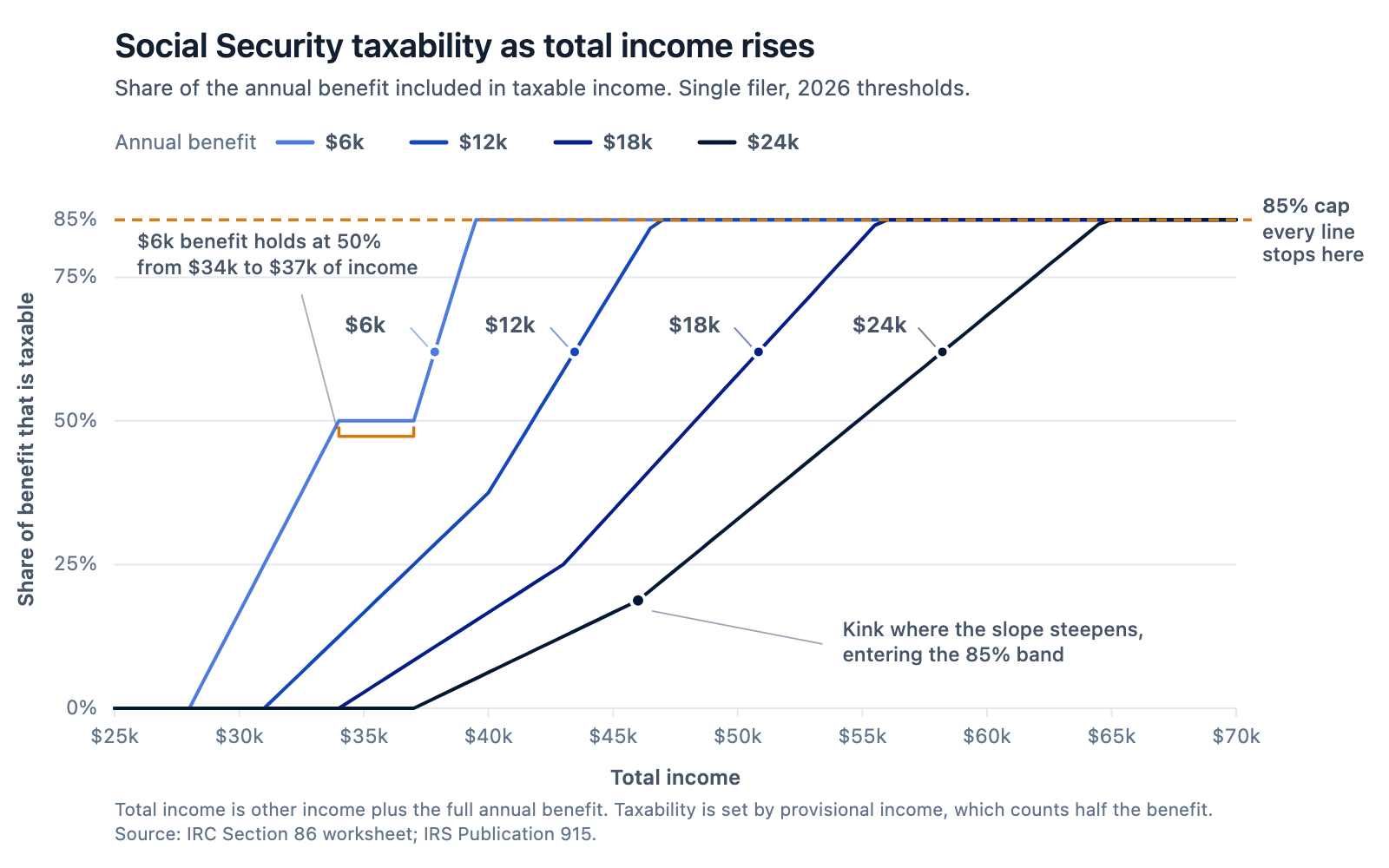
Note also that the slope of the lines varies as we pass through the bands. For the $6k benefit, there is a range from $34k-$37k of total income where taxability remains at 50%. For the other examples, the line gets steeper when we move into the 85% taxability bracket. (You’ll see a kink in the line there.) But all lines max out at 85% taxability.
The senior deduction did not make Social Security tax-free
The OBBBA, signed July 4, 2025, created a temporary deduction for taxpayers age 65 and older. It did not amend Section 86, did not move the thresholds, and did not change how much of any benefit is included in income. Although a change in taxability of benefits was discussed in the media in the run-up to the bill, the proposal to exempt benefits from tax never made it into the final law. What passed instead, per the IRS summary of the act’s deductions, is a deduction with these terms:
- $6,000 per qualifying individual, so up to $12,000 for a married couple where both spouses are 65 or older. The amount is fixed and does not adjust for inflation.
- Age 65 by year end. Eligibility is based on age, not on receiving benefits. A 62-year-old early claimant, a disabled worker, or a younger survivor gets nothing from it; a 66-year-old who has not yet claimed gets the full deduction.
- Tax years 2025 through 2028. It expires after 2028 unless Congress extends it.
- A phase-out at higher incomes. Each qualifying individual’s $6,000 shrinks by 6% of the amount by which modified adjusted gross income (MAGI) exceeds $75,000 (single) or $150,000 (joint). A single filer’s deduction is gone entirely at $175,000 of MAGI; a couple where both spouses qualify sees the combined $12,000 exhausted at $250,000. Note that this definition of “modified adjusted gross income (MAGI)” is not the same as the standard AGI + tax-exempt income we saw earlier, and that is used in other parts of the tax code. Instead, the MAGI used for OBBBA deductions is AGI + any amount excluded from gross income under IRC §§ 911, 931, or 933 (relating to foreign earned income and certain U.S. territory/possession income). In practice, this is simply equivalent to AGI for most taxpayers.
- Available whether or not the client itemizes, and stacked on top of the long-standing additional standard deduction for those 65 and older. Claiming it requires the qualifying individual’s Social Security number on the return, and married taxpayers must file jointly to claim it. It is not available for taxpayers using the married filing single option.
Let’s run Frank and Nancy through this deduction math. Their MAGI of $104,000 is below $150,000, so they get the full $12,000. If their marginal rate is 12%, the deduction saves them $1,440 of federal tax ($12,000 x 12%). That is real money. But $34,000 of their Social Security is still taxable income, computed by exactly the same formula as before the law passed. Their benefits were not made tax-free; their taxable income was reduced by a deduction that expires after 2028.
This distinction matters for planning, not just precision. A deduction that phases out with MAGI is itself a threshold to manage: a Roth conversion that pushes a 68-year-old couple from $150,000 to $200,000 of MAGI costs them $6,000 of their combined $12,000 senior deduction on top of the ordinary tax, and can also raise Medicare premiums through the income-related monthly adjustment amount (IRMAA). The 2025 law added a threshold; it didn’t remove one.
Advisor takeaway: When a client says “I heard Social Security isn’t taxed anymore,” the accurate answer fits in three sentences. The taxation formula did not change, and up to 85% of benefits remain taxable based on provisional income. What you may have through 2028 is an extra $6,000-per-person deduction if you are 65 or older, phasing out above $75,000 or $150,000 of MAGI. It lowers your tax bill; it does not make your benefit tax-free.
The tax torpedo: why marginal rates spike in the phase-in range
The phase-in ranges create a marginal-rate distortion that advisors often call “the tax torpedo.” In the 85% tier, before taxability caps out, one more dollar of IRA withdrawal raises provisional income by a dollar and drags another 85 cents of Social Security into taxable income. Each withdrawn dollar adds $1.85 to taxable income. In other words, tax rates are 85% higher in that range than they appear on paper.
Take Alan from the example above, still $2,300 below his 85% cap. If he withdraws an extra $1,000 from his IRA, his taxable income rises by $1,850: the $1,000 itself plus $850 of newly taxable benefits. At a 12% bracket, the effective marginal rate on that withdrawal is 22.2%. At a 22% bracket, it is 40.7%. In the 50% band, the same mechanics run at a 1.5 multiplier.
The torpedo has an exit as well as an entrance. Once the 85% cap applies, as it does for Frank and Nancy, additional income no longer drags any benefits with it, and the effective marginal rate falls back to the nominal bracket rate. For many clients, this produces a counterintuitive result: the most expensive place to take a marginal dollar is the middle of the phase-in band, not above it.
How the tax actually gets paid
Taxable Social Security benefits have no automatic federal withholding. A client covers the bill one of two ways: voluntary withholding from the benefit itself, or quarterly estimated payments alongside their other income.
Voluntary withholding runs through Form W-4V, which offers exactly four flat rates: 7%, 10%, 12%, or 22% of each payment and, per the form’s own instructions, “no other percentage or amount.” The completed form goes to the Social Security Administration, not the IRS, and beneficiaries can also start or change withholding online through their “my Social Security” account. The math is quick to check against the worked examples above: Alan’s $21,500 of taxable benefits at a 12% bracket adds roughly $2,580 of federal tax for the year, and a 10% election on his $28,000 benefit withholds $2,800, covering it with a small cushion. Clients who prefer estimates use Form 1040-ES on the usual quarterly schedule; either route works, but doing neither invites an underpayment penalty in April. For a household unsure whether benefits are taxable at all, the IRS Interactive Tax Assistant walks through the determination in about nine minutes.
How advisors sequence withdrawals around provisional income
Because every component of provisional income is a planning variable, the order and source of withdrawals can change how much of a client’s Social Security is taxed, year after year. The starting point is knowing what counts:
| Income source | Counts toward provisional income? |
|---|---|
| Traditional IRA and 401(k) withdrawals | Yes |
| Pension income (taxable portion) | Yes |
| Wages and self-employment income | Yes |
| Capital gains and dividends | Yes |
| Municipal bond interest | Yes, added back despite being tax-exempt |
| Taxable portion of annuity payments | Yes |
| Social Security benefits | Yes, but only 50% of benefits count |
| Qualified Roth IRA withdrawals | No |
| Qualified charitable distributions (QCDs) from IRAs | No, excluded from AGI |
| Qualified health savings account (HSA) withdrawals | No |
| Return of basis from taxable accounts | No, only the gain counts |
From that table, the sequencing plays follow directly:
- Position Roth conversions before benefits begin. In the window between retirement and claiming, a conversion raises AGI but there is no benefit in pay to drag into taxation. The same conversion executed five years later, with $40,000 of benefits flowing, can trigger the 1.85 multiplier through the phase-in band. Claiming age and conversion schedule are one decision, not two; see our Social Security claiming strategy guide.
- Fund the paycheck from Roth or basis in threshold years. For a household sitting just below a threshold, like Mark and Susan at $42,000, sourcing the next $5,000 of spending from a Roth account or from taxable-account basis instead of the 401(k) keeps them out of the 85% tier entirely.
- Use QCDs for charitable clients past age 70½. A qualified charitable distribution from an IRA or inherited IRA satisfies charitable intent, and required minimum distributions for clients subject to them, without ever entering AGI or provisional income. The same gift written from a checking account funded by an IRA withdrawal counts in full.
- Do not reach for municipal bonds as a fix. Swapping taxable bonds for munis lowers AGI, but the interest is added straight back in the provisional income test. For this specific problem, munis solve nothing.
- Mind the stacked thresholds. Provisional income tiers, the senior deduction phase-out, and, for clients age 63 and older, the IRMAA brackets all key off overlapping MAGI-based measures (though possibly with different definitions of MAGI). A single withdrawal decision can cross two of them at once. The 2026 IRMAA brackets and MAGI thresholds are the next set of lines to check, and state rules add another layer, covered in our guide to state taxes in retirement.
Running this by hand for one household in one year is feasible. Running it across a full client base, every year, against thresholds that interact, is not a spreadsheet exercise. Income Lab’s Tax Lab runs 20 tax-aware distribution strategies in parallel and computes Social Security taxability year by year from the actual progressive thresholds, which makes the choice in front of Mark and Susan visible on screen: fund next year’s $5,000 from the 401(k) and the income graph shows their taxable benefits climbing as provisional income crosses the $44,000 line; fund it from the Roth and the benefit line does not move. Because the analysis is connected to the full financial plan rather than a one-year tax snapshot, that consequence lands in the multi-year projection, not as a surprise the following April. The tax engine is one layer of a platform built to be second to none in the full lifecycle of financial planning; withdrawal sequencing is simply where the depth shows first.
Advisor takeaway: Provisional income is a planning variable, not a fact of nature. The account you draw from, the year you convert, the way a charitable gift is routed, and the claiming date all move it. The households that overpay are usually not the ones with the most income; they are the ones whose withdrawals were never sequenced against the thresholds.
FAQ
Is Social Security taxable?
Yes, for many households. According to the IRS, up to 85% of Social Security benefits can be included in federal taxable income, depending on “provisional income”, which is calculated as adjusted gross income excluding Social Security, plus tax-exempt interest, plus half of Social Security benefits. Below $25,000 of provisional income for single filers or $32,000 for joint filers, benefits are not taxed at all. The Social Security Administration reports that fewer than 10% of beneficiaries paid tax on benefits in 1984; because the thresholds have never been indexed for inflation, its MINT model projects that more than half now do.
What is provisional income?
Provisional income is the measure used to determine how much of a Social Security benefit is subject to federal income tax. It equals adjusted gross income (computed without Social Security), plus tax-exempt municipal bond interest, plus 50% of the year’s Social Security benefits. The Social Security Administration calls the same figure “combined income.” It is compared against fixed thresholds ($25,000 and $34,000 for single filers, $32,000 and $44,000 for joint filers) to place the household in the 0%, 50%, or 85% inclusion tier.
Did the One Big Beautiful Bill Act (OBBBA) make Social Security tax-free?
No. The OBBBA did not change the taxation of Social Security benefits. It created a temporary deduction of $6,000 per person age 65 and older ($12,000 for a qualifying couple) for tax years 2025 through 2028, phasing out above $75,000 of MAGI for single filers and $150,000 for joint filers. The deduction lowers taxable income for those who qualify, but the provisional income formula, the thresholds, and the 0/50/85 tiers are unchanged, and beneficiaries under age 65 receive no deduction at all.
At what income level is Social Security not taxed?
Benefits escape federal tax entirely when provisional income (MAGI + ½ of Social Security benefits) is at or below the base amount: $25,000 for single filers, heads of household, and qualifying surviving spouses, and $32,000 for married couples filing jointly. Because only half of the benefit counts toward the test, a retiree whose income is mostly Social Security often owes nothing on it.
Do Roth IRA withdrawals count toward provisional income?
No. Qualified Roth IRA withdrawals are excluded from adjusted gross income, so they do not enter the provisional income calculation. This is one of the quieter arguments for Roth conversions: dollars converted early, for many clients in the years before claiming, come out later without dragging Social Security benefits into taxable income.
Do states tax Social Security benefits?
Most states do not, and the list of states that do tax benefits shrinks nearly every year. Only eight states still tax benefits for tax year 2026: Colorado (under age 65; at age 65 and older, benefits are fully exempt), Connecticut, Minnesota, Montana, New Mexico, Rhode Island, Utah, and Vermont. West Virginia was the ninth until this year; its three-year phase-out reached a full 100% exemption in tax year 2026, per the West Virginia Tax Division. Where benefits are still taxed, exemptions and income thresholds vary widely, layering on top of the federal calculation. See our guide to state taxes in retirement for the state-by-state picture.
Recommended reading
- Explaining Social Security taxes to clients: the client-conversation companion to this guide
- Social Security Masterclass: the taxation of Social Security (video)
- 2026 IRMAA brackets and MAGI thresholds
- Social Security claiming strategy guide
- Guide to state taxes in retirement
The provisional income formula has not changed in over three decades, and the 2025 law left it untouched. What changes every year is where your clients sit relative to thresholds that never move. To watch one household’s withdrawals resequenced against those thresholds, with the taxable share of their benefit recomputed year by year, Book a Walkthrough.
Sources
- Internal Revenue Service, Social Security Income (FAQs)
- Internal Revenue Service, Publication 915: Social Security and Equivalent Railroad Retirement Benefits
- Internal Revenue Service, About Form W-4V, Voluntary Withholding Request
- Internal Revenue Service, Interactive Tax Assistant: Are my Social Security or railroad retirement tier I benefits taxable?
- Internal Revenue Service, Social Security Income FAQs: Regular and Disability Benefits
- West Virginia Tax Division, Social Security Modification
- Internal Revenue Service, One, Big, Beautiful Bill Act: Tax deductions for working Americans and seniors
- Internal Revenue Service, Understanding the One Big Beautiful Bill: Individual Tax Provisions
- Internal Revenue Service, Tax inflation adjustments for tax year 2026
- Patrick J. Purcell, Social Security Administration, Income Taxes on Social Security Benefits, Issue Paper No. 2015-02
- Social Security Administration, Historian’s Office, Research Note #12: Taxation of Social Security Benefits
- Kiplinger, Social Security Email About ‘Big Beautiful Bill’ Tax Changes Sparks Confusion

Continue Reading
Ready to see this in action?
Watch how Income Lab helps advisors answer clients' toughest retirement income questions with guardrails-based planning.
Book a Walkthrough Start Free Trial