
Withdrawal OptimizerA tool inside Penny · Available September 8
Your client needs cash.
Where should it come from?
Withdrawal Optimizer takes the amount your client asked for and shows you which accounts should fund it, what it costs in tax, and where the answer sits against the bracket and Medicare lines you care about. It renders instantly and updates live as you type.
Part of Penny, which comes with Income Lab Pro, along with plan building, intake, and in-meeting answers.

The Problem
The plan says how much. This is the part that says where from.
A client calls in the middle of the year and needs money. It is one of the most common requests an advisor gets, and it arrives without notice, in the middle of a plan that was built for a normal year. The answer that satisfies the client and the answer that is correct are rarely the same answer.
This is the third question Income Lab has always answered, and it is the one advisors get asked in the room: not how likely the plan is to work, but how much your client can spend, and where the money comes from. Withdrawal Optimizer answers that question in dollars, on the plan you already built, while the client is on the phone.
The answer, in the product · Illustrative data
Hover or tap a readout to look closer
How It Works
How Withdrawal Optimizer decides
Enter the amount your client needs. The answer is there as you type, and it changes as you change the inputs.
It answers at the account level
You get a funding plan: which accounts should fund the request, how much comes from each, and what the whole thing costs in tax. Because Penny already holds the plan and the account structure, nothing has to be rebuilt to ask the question.
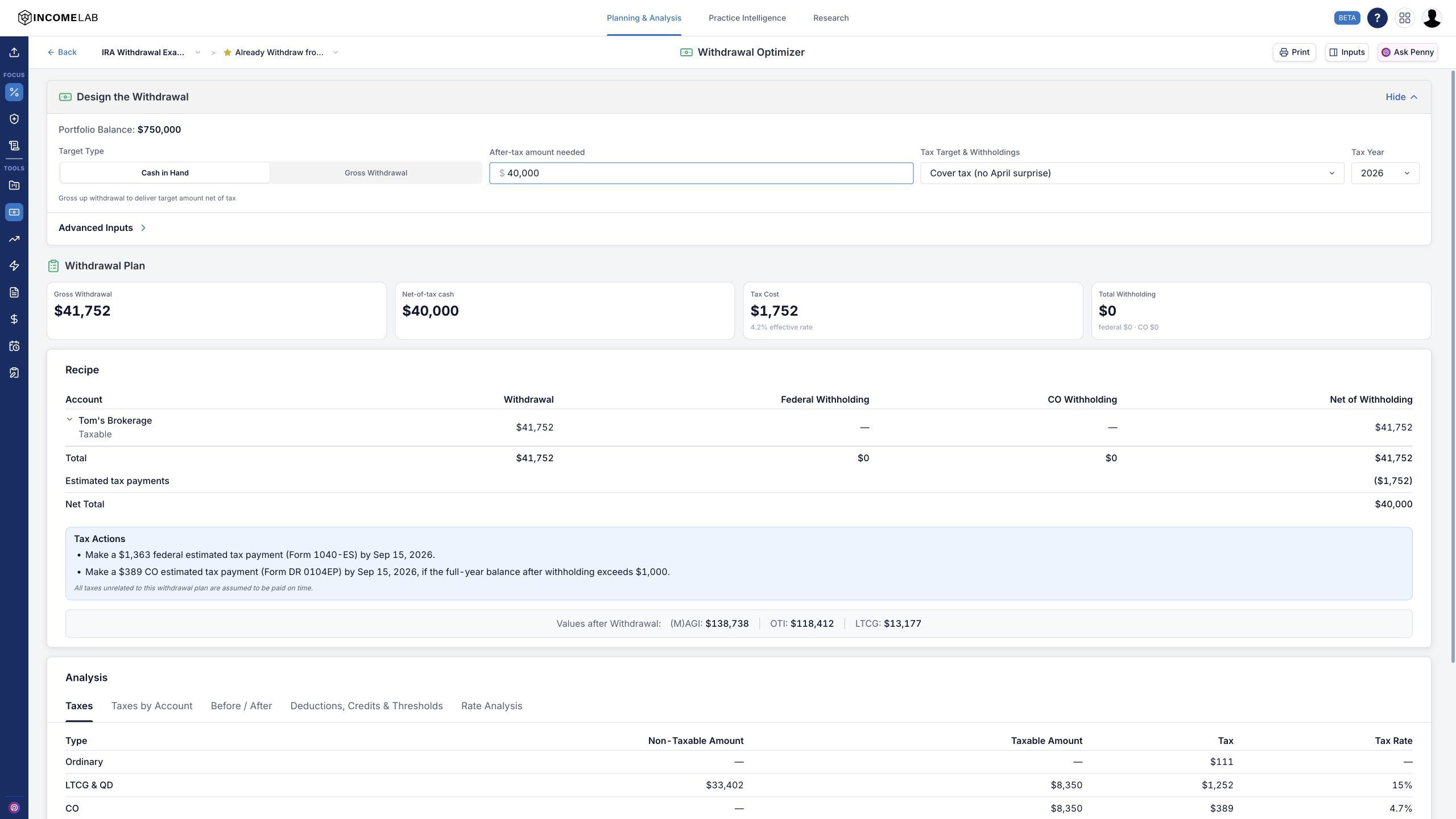
It is tax-aware by default, before you touch a setting
Working from the current year's tax picture in the plan, it prefers taxable accounts over tax-deferred and tax-free, keeps Roth dollars in reserve because Roth balances cannot easily be replenished, harvests losses against realized gains, and looks for room in the 0% long-term capital gains bracket. Every one of those preferences is yours to change.
It shows you the lines before you cross them
Set a cap on a federal ordinary income bracket, on the long-term capital gains bracket, on MAGI for Medicare IRMAA, or on MAGI for ACA credits at 400% of the federal poverty limit. The plan then works inside the cap you set, and the screen tells you where the client sits right now relative to that line.
Crossing one Medicare IRMAA tier can cost a couple as much as about $3,500 a year in Part B and Part D surcharges, and because IRMAA looks back two years, the number you shape this year sets a premium two years out.
You can override any of it
Exclude an account. Cap what comes out of a given account, which is how advisors protect an annuity living benefit. Set an account waterfall so the plan draws in the order you want, by category, rather than the order the tax math would pick. Hold the current allocation instead of optimizing for tax. The defaults are what most advisors want; the controls are there for when they are not.
It can fold charitable giving in
For charitably inclined clients, gifts of cash or appreciated property to public charities, donor-advised funds, or private foundations can be planned alongside the same request. It works out the AGI caps on the deduction and shows the new deductions the gift creates.
The math is deterministic
Penny uses deterministic financial models for the calculations. Penny explains the answer; it does not do the arithmetic.
The output prints, and you choose which sections of it to include.
Category Proof
Advisors already chose Income Lab for this category
#1 Retirement Distribution Planning tool by market share, three years running.
T3/Inside Information Advisor Software Survey, 2024 to 2026.
Nearly 2x the market share of the next tool in the 2026 T3 survey.
T3/Inside Information Advisor Software Survey, 2026 edition.
18.49% of advisors have adopted a retirement distribution planning tool, against 83.3% who use planning software at all.
T3/Inside Information 2026. The category is early, and the client question is not.
T3/Inside Information Advisor Software Survey, 2026 edition, retirement distribution planning category, printed page 22.
Scope
Straight answers about scope
What it does
- Plans a one-time withdrawal layered on top of the client's existing Income Lab plan.
- Names which accounts should fund the request, and what the request costs in tax.
- Works from the current tax year's picture in that plan.
- Produces a withdrawal plan the advisor executes.
What it does not do
- It does not trade, move money, or file or pay anything. It plans and quantifies.
- It does not edit the client's plan. Penny analyzes and recommends; every change to the plan is made and approved by the advisor.
- Year-over-year strategy is not this tool's job. That is Tax Lab.
Part of Penny, which comes with Income Lab Pro, along with plan building, intake, and in-meeting answers.
Live webinar
60 minutes
Your Client Needs Cash. Where Should It Come From?
Justin Fitzpatrick walks through the decision live: the request comes in, the plan is already built, and the question is which accounts answer it. Bring your own case shape and watch it get worked.
- The request
- The funding plan
- The tax cost
Withdrawal Optimizer is available September 8.
 Your host
Justin Fitzpatrick
PhD, CFA, CFP®
President & Co-Founder
Income Lab
Questions Advisors Ask
Frequently Asked Questions
What is Withdrawal Optimizer?
Withdrawal Optimizer is a tool inside Penny that plans a one-time withdrawal on top of a client's existing Income Lab plan. Enter the amount the client needs and it shows which accounts should fund it and what the request costs in tax, using the current year's tax picture from that plan.
Which accounts does it draw from?
By default it prefers taxable accounts over tax-deferred and tax-free accounts, keeps Roth dollars in reserve because they cannot easily be replenished, harvests losses against realized gains, and looks for room in the 0% long-term capital gains bracket. You can exclude accounts, cap what comes from any account, or set your own account waterfall by category, and the plan will follow your order instead.
Can it keep a client under a Medicare IRMAA tier?
You can set a cap on MAGI, either at an IRMAA tier or at a figure you enter, and the plan will work inside that cap. In 2026, Medicare IRMAA surcharges run from $0 to $13,872 a year for a couple, depending on income. IRMAA looks back two years, so income shaped in the current year sets a premium two years out. Income Lab does not lower a client's baseline income; the cap keeps a withdrawal from adding to it.
Does it place the trades?
No. Withdrawal Optimizer produces a withdrawal plan the advisor executes. It does not trade, move money, or file or pay anything.
Does it change the client's plan?
No. Penny does not edit the client's plan. It analyzes and recommends, and every change to the plan is made and approved by the advisor.
Does it work for a client with a charitable goal?
Yes. Gifts of cash or appreciated property to public charities, donor-advised funds, or private foundations can be planned alongside the same request. It works out the AGI caps on the deduction and shows the new deductions the gift creates.
Is the answer produced by AI?
The calculations are deterministic. Penny interprets your question and explains the result; it does not do the arithmetic.
How do I get it?
Withdrawal Optimizer is part of Penny, which comes with Income Lab Pro, along with plan building, intake, and in-meeting answers. Book a walkthrough and we will run a case shaped like yours.
Bring us a real request.
Pick a case where a client asked for cash and the answer was not obvious. We will run it.