
A client nearing retirement wants to know how much they can spend. They may also ask what happens if markets disappoint, inflation rises, or they live longer than expected. A useful plan should answer all of those questions in terms they can act on.
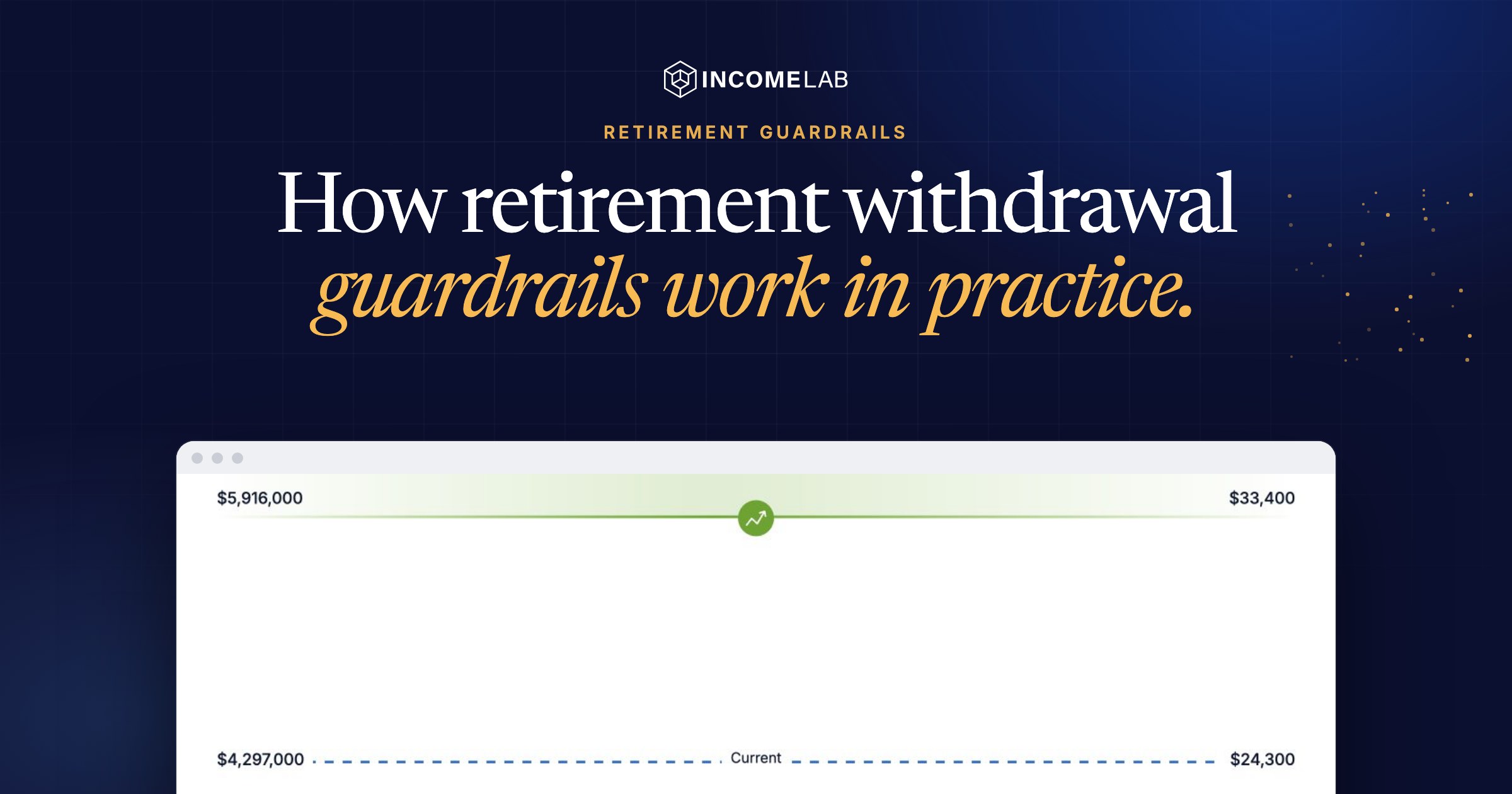
Income Lab expresses sustainable spending in monthly or annual dollars and shows the portfolio balances at which the plan would call for reconsidering that amount. Those thresholds establish expectations before market conditions change, leading to greater advisor credibility and trust.
This article explains how the spending amount and guardrails are calculated, why they change over time, and how an advisor can use them in ongoing conversations with clients.
What retirement guardrails are
A client-centered retirement plan clearly answers the question, “How much can I spend?” A plan with retirement income guardrails begins by answering this question, in dollar terms, with a “retirement paycheck”. Retirement guardrails then establish portfolio-balance thresholds for reviewing that spending. Crossing the upper guardrail may justify an increase. Crossing the lower guardrail calls for a measured adjustment to spending or another aspect of the plan.
Three characteristics of Income Lab’s risk-based approach are particularly important.
Guardrails are expressed as portfolio balances. For example, a hypothetical upper guardrail of $3,000,000 could indicate that monthly spending could increase from $10,300 to $11,200. The balance is the threshold; the spending amount is the potential adjustment.
Guardrails are derived from risk in the full plan. Their levels reflect portfolio assets, income and expenses, Social Security timing, inflation, longevity, spending goals, and other aspects of the household situation. They are not fixed percentage changes in portfolio value or withdrawal rates.
Guardrails change over time. As a client ages, receives income, makes withdrawals and deposits, and experiences different investment and inflation outcomes, the level of risk associated with a given portfolio balance changes too.
How the monthly dollar answer gets produced
Income Lab calculates sustainable spending by applying the household’s financial plan to a range of possible market and inflation outcomes. It then identifies a spending amount consistent with the risk preference selected for that household.
Under Income Lab’s published methodology, the model evaluates 1,000+ return-and-inflation scenarios. The default risk setting uses a 20th-percentile spending outcome, corresponding to a 20% “risk of overspending” or an 80% “risk of underspending”. Advisors can adjust that risk setting to fit the client’s circumstances and preferences.
The calculation reflects portfolio balances and allocation, fees, Social Security and pension benefits, the planning horizon, and the timing of other spending goals. It also accounts for sequence-of-inflation risk and mortality risk, two risks that are typically not modeled or accounted for in financial planning software. It can also accommodate spending that changes with age rather than assuming a flat inflation-adjusted amount throughout retirement. Research on retirement spending patterns, including Blanchett (2013), informs these assumptions.
The result is a sustainable monthly spending amount the client can use in planning decisions.
Where the two guardrail levels come from
Each guardrail represents a portfolio balance at which the risk associated with the current spending level has changed enough to warrant an adjustment.
| Guardrail | What that balance level signals | What the plan recommends |
|---|---|---|
| Upper | Current spending has become “too conservative” given the plan and plan resources. Risk of underspending and regret is too high. | Increase spending or discuss other productive use of assets |
| Lower | Current spending has moved into the middle of the overspending zone. Current spending is outrunning current resources and the risk of overspending is likely too high. | Reduce spending, or make another plan change, gradually |
The upper and lower guardrails respond differently. When the upper guardrail is reached, an Income Lab plan will typically call for increasing spending to the point where over- and under-spending risk are back to the original targets. At the lower guardrail, a plan will typically call for a smaller initial reduction, closing about 10% of the gap between current spending and the underlying risk-based target. This measured response helps avoid large cuts followed by large increases if markets recover (whipsawing).
Portfolio performance is one influence on guardrails, but not the only one. Lower spending than expected, changes in inflation, and the timing of income or expenses can also affect whether a household has room to spend more.
Advisors can set a minimum income-change threshold, such as 5%, to avoid recommending adjustments too small to matter to the client. This setting applies to inflation-related and guardrail-related changes.
When retirement guardrails trigger a spending adjustment
Income Lab recalculates the guardrails as the tracked plan is updated each month. That does not mean it calls for a new spending amount every month. An adjustment arises when the relevant conditions are met and the resulting change exceeds the household’s minimum income-change setting. With the default conservative risk target, favorable outcomes may often create opportunities to increase spending, although actual results depend on market conditions and the client’s circumstances.
The updated thresholds reflect changes in age, portfolio value, inflation, and the household’s planned cash flows. The client’s existing spending guidance remains in place until the monitoring process identifies a sufficiently meaningful adjustment.
If the lower guardrail is reached, the advisor can consider several responses: reduce current spending, postpone or reduce planned expenses, or revise the portfolio legacy goal. The right response depends on the client’s priorities and the flexibility of their plan.
Discussing the guardrails when the plan is first presented helps clients understand future changes. An adjustment then becomes an expected part of how their retirement strategy is managed, with the advisor able to explain the conditions that prompted it.
Guardrails and “probability of success”
“Probability of success” is a statistic central to most legacy financial planning software used today. The score reports the share of modeled scenarios in which a specified spending plan does not run out of money. However, this measurement has numerous well-known and widely discussed problems, both technical and psychological. Industry thought leaders are close to unanimous in calling for advisors to move away from this problematic approach.
The guardrails approach rejects success/failure framing entirely and simply answers client questions directly, starting with “how much can I spend?” Income Lab’s approach identifies an amount the household could reasonably plan to spend, together with the conditions under which that amount should change.
For clients, the practical benefit is a recommendation they can relate to their monthly spending, accompanied by a clear process for evaluating changes over time.
How risk-based guardrails differ from withdrawal-rate guardrails
Guyton-Klinger guardrails helped popularize systematic spending adjustments in retirement. Income Lab’s risk-based guardrails use a different trigger: a portfolio balance derived from the risk characteristics of the client’s complete plan. Research by Tharp and Fitzpatrick, alongside work by other retirement researchers, explains the limitations that fixed withdrawal-rate triggers can encounter.
| Dimension | Withdrawal-rate guardrails | Risk-based guardrails |
|---|---|---|
| Trigger | A withdrawal rate crossing a fixed percentage | A portfolio balance crossing a recalculated risk threshold |
| Inputs | Portfolio and withdrawal rate | The full plan, including cash flows, longevity, mortality, and inflation |
| Spending shape | Assumes a steady withdrawal pattern | Handles uneven spending, including higher withdrawals while Social Security is deferred |
| Client age | Rate parameters are fixed at plan creation; common implementations also suspend spending cuts in the final 15 years rather than adapting them | Thresholds update as the client ages |
| Update cadence | Set at plan creation | Recalculated monthly |
Consider a household that delays Social Security until age 70. Portfolio withdrawals may be unusually high during the intervening years and decline once benefits begin. A withdrawal-rate trigger can interpret that temporary change as a deterioration in the plan even when the cash flows were anticipated. Risk-based guardrails account for the planned timing of income and spending, an issue Tharp and Fitzpatrick describe as the retirement distribution “hatchet.”
Retirement guardrails example with two households
The following hypothetical cases illustrate how an advisor might explain the results. The values are rounded and are not projections or recommendations for an actual household.
Household A is a recently retired married couple, both age 66, with a $2,400,000 portfolio. The higher earner plans to claim Social Security at 70. Essential expenses are about $6,000 per month, and their minimum income-change setting is 3%.
| Measure | Illustrative amount |
|---|---|
| Portfolio balance today | $2,400,000 |
| Sustainable spending today | $9,500 a month |
| Upper guardrail (portfolio balance) | $3,000,000 |
| Spending target if the upper guardrail is reached | About $11,200 a month |
| Lower guardrail (portfolio balance) | $1,900,000 |
| Spending after a lower guardrail adjustment | About $9,150 a month |
An advisor might explain the plan this way: “You can currently plan on spending about $9,500 a month. If your portfolio reaches the upper guardrail of $3,000,000, the plan would support an increase to approximately $11,200. If it reaches the lower guardrail of $1,900,000, we would consider a smaller reduction to about $9,150 and review alternatives, such as postponing a planned car purchase.”
The lower-guardrail adjustment in this illustration is about 4%, even though the decline in the portfolio is much larger. If conditions continue to worsen, later reviews may call for further adjustments. The purpose is to respond carefully rather than make an unnecessarily large change at the first warning.
Household B is a hypothetical single retiree, age 71, with a $1,100,000 portfolio and sustainable spending of about $5,200 per month. The upper guardrail is $1,350,000 and the lower guardrail is $900,000. After strong returns and lower-than-expected inflation, reaching the upper guardrail could support an increase to roughly $5,900 per month. This provides an opportunity to discuss what additional spending would mean for the client’s life.
Understanding guardrails through historical scenarios
Advisors can also use Income Lab’s Retirement Stress Test to see how the plan and spending guidance would have responded to historical conditions such as the Great Depression, the inflationary 1970s, and the Global Financial Crisis. This offers a concrete way to discuss the risks and potential adjustments before they occur.
What this changes in the advisor’s client conversation
The practical value of guardrails is that they give clients a current spending recommendation and a defined process for revisiting it. Advisors can discuss both the lifestyle that the plan supports today and the circumstances that could justify spending more or less later.
That framework can make ongoing reviews more useful. The advisor can explain how the plan has changed, whether the household remains within its no-change range (between the guardrails), and what actions, if any, are appropriate. When Income Lab monitors a plan over time, these discussions can draw on updated results rather than a static projection from the previous meeting.
How Income Lab produces the answer
Income Lab calculates sustainable monthly spending and risk-based guardrails from the household’s integrated financial plan, including assets, planned spending, outside income, and other relevant assumptions. For plans placed under automatic monitoring, it updates the calculations as time passes and new balance and inflation information becomes available. Advisors can show the spending recommendation and guardrail levels in client-facing views, making the analysis usable in a real planning conversation.
Additional detail is available in Income Lab’s guide to risk-based guardrails and its materials on explaining the retirement paycheck and guardrails. Advisors comparing approaches can also review the differences among bucket strategies, withdrawal-rate guardrails, and risk-based guardrails.
Book a walkthrough to see how a client’s spending recommendation and guardrails are calculated from an integrated plan.
Frequently asked questions
What is a guardrails approach to retirement withdrawals?
Risk-based guardrails give a retiree a sustainable monthly spending amount and two portfolio-balance thresholds. Reaching the upper guardrail may support an increase. Reaching the lower guardrail signals a need to consider a smaller spending adjustment or another change to the plan. The levels are recalculated as the tracked plan changes.
How often do guardrails actually trigger a change?
For plans under tracking and monitoring, guardrail levels are generally recalculated monthly. Spending adjustments are recommended when the conditions for a change are met and the change exceeds the minimum income-change threshold selected for that household. Otherwise, the client may remain in the no-change range. A typical plan may see an adjustment, either for inflation or hitting a guardrail, once every 1-3 years. Time between hitting a guardrail can be as much as 5-10 years.
How big is a spending cut when the lower guardrail is hit?
Income Lab generally begins by closing about 10% of the gap between current spending and the underlying risk-based target. This often produces a relatively modest initial reduction (4-10%), although the amount depends on the plan and the size of the gap.
Are risk-based guardrails the same as Guyton-Klinger guardrails?
No. Traditional Guyton-Klinger guardrails use changes in the portfolio withdrawal rate as a trigger. Income Lab’s risk-based guardrails use portfolio-balance thresholds derived from the complete plan, which change as the household ages and its circumstances evolve.
Is a guardrails answer different from a probability of success score?
Yes. Probability of success measures downside risk only: the risk of running out of money. This approach has many well-known problems and many advisors have abandoned its use with clients. Risk-based guardrails estimate sustainable spending and identify circumstances that call for a change. Guardrails express the result in monthly dollars and provide an ongoing adjustment framework.
What happens to guardrails when a client ages?
They are recalculated to reflect the shorter remaining planning horizon, changing income and expenses, inflation, and portfolio conditions. The guardrails for a 75-year-old household will generally differ from those calculated for that same household at age 65.
Sources
-
Income Lab methodology, “How are the retirement paycheck and guardrails calculated”
-
Income Lab methodology, “Are Income Lab guardrails based on Guyton-Klinger guardrails”
-
Income Lab methodology, “Guardrails in the Retirement Stress Test and tracked plans”
-
Income Lab methodology, “How are a plan’s guardrails and spending capacity calculated”
-
Income Lab FAQ, “What is minimum income change”
-
Income Lab, “Explaining the Retirement Paycheck and Guardrails”
-
Income Lab, “Retirement Stress Test tutorial”
-
Tharp, D. and Fitzpatrick, J., “The Retirement Distribution ‘Hatchet’: Using Risk-Based Guardrails To Project Sustainable Cash Flows”, Kitces.com, November 24, 2021
-
Tharp, D. and Fitzpatrick, J., “Why Guyton-Klinger Guardrails Are Too Risky For Most Retirees (And How Risk-Based Guardrails Can Help)”, Kitces.com, March 27, 2024

Continue Reading
Ready to see this in action?
Watch how Income Lab helps advisors answer clients' toughest retirement income questions with guardrails-based planning.
Book a Walkthrough Start Free Trial