
A recently retired client calls in March. Her investments have performed well, and she wants to know whether she can spend more this year. She also needs $60,000 for a home project and asks where the cash should come from. Those questions require different but connected analyses. The advisor needs an updated spending recommendation, then a way to evaluate which accounts and holdings can fund the request, taking taxes, investment allocation, and other constraints into account.
Many planning applications project the sustainability of a long-term plan. Retirement distribution tools go further into spending decisions, tax-aware funding, or the ongoing work of implementing and monitoring a strategy. The 2026 T3/Inside Information survey reported adoption of dedicated retirement distribution tools by 18.49% of advisors, compared with 83.3% for financial planning software. That gap makes it worth asking how a firm turns a plan into actionable income guidance. This article compares several approaches to that problem.
What a withdrawal and distribution strategy tool is
Retirement withdrawal and distribution strategy tools help advisors determine sustainable spending, identify appropriate sources of cash, or manage the implementation of retirement income. Some focus primarily on tax-aware sourcing across account types; others provide spending guidance, monitoring, or execution capabilities. The scope varies substantially, so no single feature defines the whole category.
Three tasks matter: determining what the client can spend, deciding where a specific withdrawal should come from, and updating those decisions as the household and markets change. For a particular cash request, the answer may depend on individual tax lots, realized gains and losses, investment exposures, RMDs, and current-year income thresholds, not simply a fixed sequence of account types.
What to look for in a distribution tool
Six questions provide a useful starting point. The importance of each depends on how the advisor manages retirement income.
| Criterion | The question to ask | Why it separates tools |
|---|---|---|
| Spending answer | Does it produce a dollar amount, or a percentage and a confidence level? | A client needs a usable spending recommendation, with its assumptions explained. |
| Adjustment rule | When markets move, does the tool tell you how much to change and when? | A recommendation needs a process for responding when conditions change. |
| Withdrawal sourcing and tax lots | Can it select accounts and holdings based on gains, losses, taxes, and investment needs? | A fixed account order misses tax-lot and portfolio tradeoffs. |
| Threshold awareness | Does it flag bracket and Medicare surcharge lines before a withdrawal crosses one? | Taxes and Medicare thresholds may change the cost of a cash request. |
| Monitoring | Does the plan update between reviews, or only when you rebuild it? | Current data and review prompts keep advice relevant. |
| Client-facing output | Can the client see the answer without the advisor interpreting it? | Client-friendly explanations help turn analysis into decisions. |
Monitoring deserves special attention. A strategy prepared at retirement may become stale after changes in portfolio values, inflation, income, or spending. In a demonstration, ask the vendor what updates automatically, which changes need advisor input, and what the system does when circumstances change.
Advisor takeaway
Ask vendors to demonstrate the second year of a client relationship, not just the first plan. What gets updated, what prompts a review, and how does the advisor know whether to recommend a change?
The landscape, and who each tool fits
These products serve different needs. Income Lab provides comprehensive financial planning with sustainable spending guidance, guardrails, and tax-aware distribution analysis in the same household model. Income Solver emphasizes coordinated withdrawal, Social Security, and investment strategies. Income Conductor centers on time-segmented income planning and monitoring. Income Discovery combines retirement income strategy with monitoring and distribution-execution workflows. The relevant comparison is how each fits the advice and service model a firm wants to deliver.
| Tool | Shape | Spending answer | Ongoing monitoring | Published price |
|---|---|---|---|---|
| Income Lab | Comprehensive financial planning platform | A monthly dollar amount with guardrails | Monthly tracking and risk-based guardrails for monitored plans | Core $1,990 a year, or $199 a month billed monthly |
| Income Solver (T. Rowe Price) | Coordinated tax, withdrawal, Social Security, and investment analysis | Retirement cash-flow and withdrawal strategies | Risk and rebalancing tools | Not published; advisor login or sales conversation required |
| Income Conductor | Time-segmented income planning | Year-by-year segment plan | Tracking and alerts in higher tiers | From $50/month; one-year commitment |
| Income Discovery | Retirement income platform, institutional | Retirement income guidance and strategy analysis | SafePath monitoring; Income Delivery execution | Contact for pricing |
Income Solver, offered through T. Rowe Price, has substantial tax and investment depth. It coordinates withdrawal strategies, Roth conversions, Medicare surcharges, Social Security, and household investment decisions. It can complement an existing planning system and includes monitoring related to risk and rebalancing. It does not produce monthly risk-based spending guidance or the guardrails process covered by Income Lab. Individual pricing is available through advisor login rather than openly posted. For advisors seeking detailed tax-aware distribution analysis alongside existing planning software, it deserves consideration.
Income Conductor focuses on time-segmented retirement income. Its published offerings include account integrations, tracking, alerts, and client reports in higher tiers. The Pro tier adds tax liquidation ordering, RMD projections, Roth conversion analysis, and other planning features. Social Security and healthcare analysis are available through Health+ on eligible tiers or included in Pro. The published entry offering starts at $50 per month with a one-year commitment. Advisors who favor a segmented approach should evaluate how its projections and monitoring fit their client process.
Income Discovery is oriented toward retirement income advice and implementation at institutional scale. Its Income Planning, SafePath monitoring, and Income Delivery offerings link strategy with ongoing guidance and quarterly distribution execution. That execution capability is an important distinction: Income Lab models withdrawals and supports advisor decisions but does not itself place trades or distribute cash. Income Discovery does not publish standard pricing, and its applicability will depend partly on a firm’s operational needs. Income Discovery is not available for smaller firms or individual advisor practices.
Income Lab approaches distribution decisions as part of a comprehensive financial plan. The same household data informs spending capacity, taxes, Social Security, insurance and annuities, and portfolio cash flows. In the 2026 T3/Inside Information survey, Income Lab had 9.08% market share in the retirement distribution planning category, compared with 4.75% for the next-ranked tool, FP Alpha. Income Lab ranked first by market share in that category in the 2024, 2025, and 2026 surveys.
Where Income Lab fits
Income Lab calculates sustainable spending as a monthly dollar amount within the client’s broader financial plan. Instead of requiring advisors to translate a probability score into an income recommendation, the plan provides a spending target and identifies the circumstances that could justify changing it. That makes “How much can I spend?” an ongoing decision rather than a one-time projection.
The ongoing adjustment framework uses risk-based guardrails. These are portfolio-balance thresholds derived from the full financial plan and recalculated as conditions change. A guardrail can lead to an increase or reduction in spending, subject to a minimum-change setting that filters out small adjustments. This differs from withdrawal-rate guardrails such as Guyton-Klinger, which rely on fixed percentage triggers based on the withdrawal rate. The linked guardrails guide explains the methodology in detail.
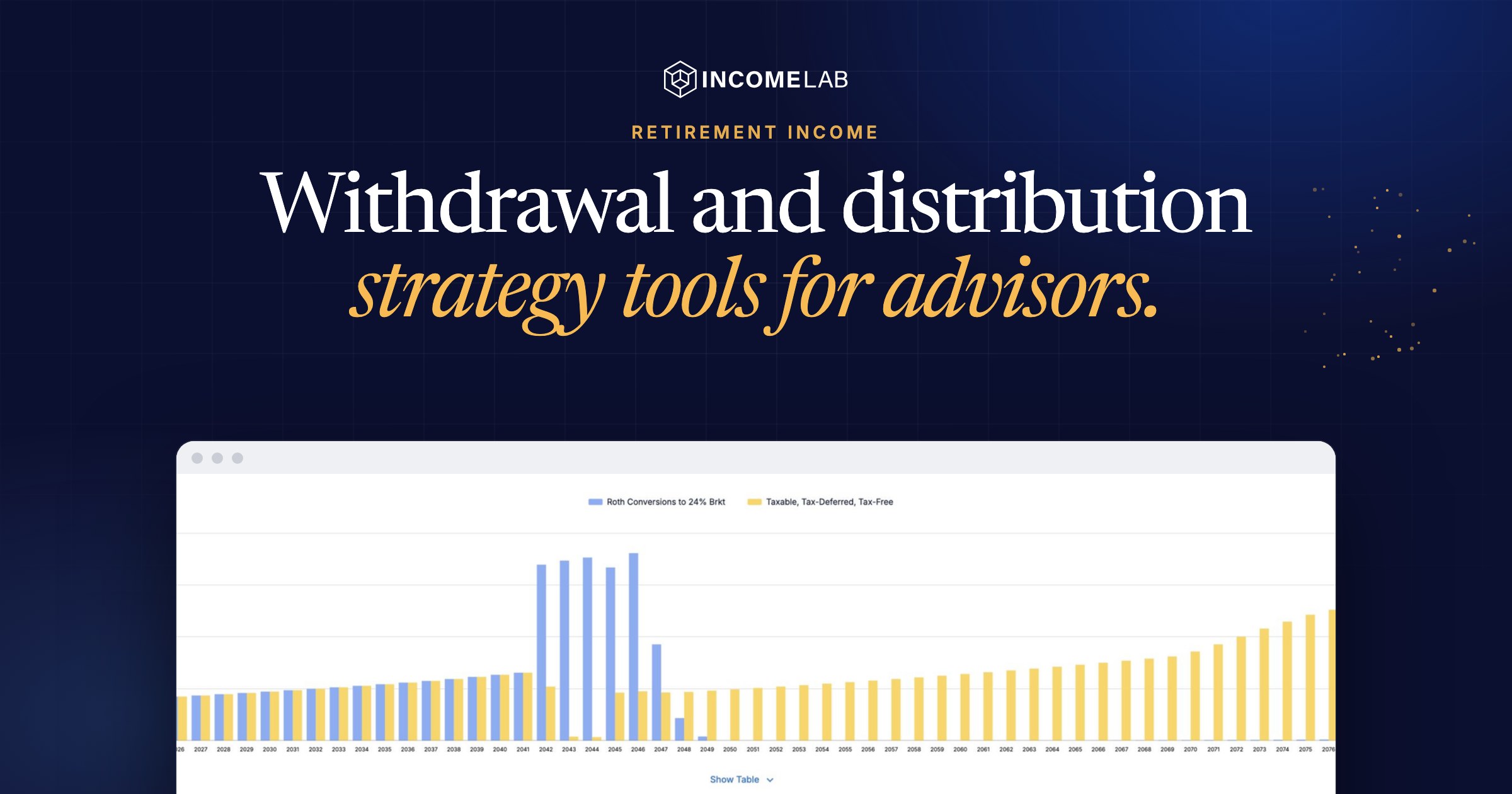
A separate question arises when a client needs a specific amount of cash. Penny’s Withdrawal Optimizer, included with Income Lab Pro, evaluates potential funding sources using the household’s current-year tax picture and the accounts and holdings in the plan. The advisor can assess which accounts and tax lots to use, consider gains and losses, apply account constraints and tax or MAGI limits, and account for RMDs or charitable giving where appropriate. It plans one-time withdrawals and supports the advisor’s instructions to the custodian; it does not execute trades or move money.
Tax thresholds can materially change a withdrawal’s cost. For example, a distribution or realized gain may push modified adjusted gross income above a Medicare IRMAA threshold, affecting premiums two years later. The 2026 CMS schedule illustrates the size of potential surcharges, but later-year thresholds and premiums are set separately. An investment-aware, plan-aware, and tax-aware process helps an advisor compare the cost of different funding choices before a withdrawal is made.
Income Lab lists Core at $1,990 annually or $199 monthly, and Pro at $2,990 annually or $299 monthly. The Withdrawal Optimizer is included in Pro.
Advisor takeaway
Evaluate the spending recommendation and the cash-sourcing decision separately, then see whether the software can connect them through the same client data. Ongoing monitoring matters because both answers can change.
Two practices, two answers
Different advisory practices may place different priorities on tax-aware funding, sustainable spending, monitoring, and execution. The right tool depends on the firm’s planning philosophy, existing technology, and service model.
Scenario A: the focused “buckets” practice
A solo RIA with 40 households, most approaching or already in retirement, uses a time-segmented approach to income planning. The advisor wants to organize retirement assets into segments designed to fund different periods of retirement and help clients understand this approach. The firm already uses separate software for comprehensive financial planning and tax analysis.
Income Conductor may be the best fit for this practice. Its time-segmented methodology aligns with the advisor’s existing approach, providing tools for building, communicating, and maintaining a retirement income strategy. The advisor can continue using other planning software for broader financial planning needs rather than replacing an established workflow.
Scenario B: the growing comprehensive planning firm
A four-advisor firm with 210 households wants more consistency across its planning process. Each advisor currently approaches retirement income and withdrawal decisions differently, often rebuilding analyses before annual reviews. The firm also wants to serve clients throughout their financial lives, from saving and education planning through retirement and estate planning.
Income Lab may be the best fit for this practice. Its comprehensive planning platform connects sustainable spending, risk-based guardrails, tax strategy, account-level withdrawal decisions, and ongoing monitoring. Advisors can work from the same financial plan when evaluating retirement spending and the tax and investment consequences of withdrawals. Automated monitoring also helps the firm deliver more consistent ongoing advice without rebuilding plans at every review.
How to evaluate the fit
When evaluating software, a useful demonstration begins with one actual retirement household: review sustainable spending, introduce a one-time cash need, compare possible funding sources, and then change a key assumption. Ask each vendor to show how the resulting strategy is communicated, monitored, and updated over time. The exercise will reveal which capabilities fit the firm’s planning philosophy and which require additional tools or manual work.
Frequently asked questions
What is a retirement withdrawal strategy tool?
It is software that supports retirement income decisions. Depending on the product, it may calculate a sustainable spending amount, assess which accounts or holdings should fund a cash request, monitor the plan, or help execute distributions. These are related but distinct functions.
How is this different from the planning software I already use?
A comprehensive planning platform may already perform some of these tasks. Distribution-specific capabilities can add depth in spending adjustments, tax-aware funding, implementation, and ongoing monitoring. Compare the actual workflows instead of assuming that every broad planning suite or specialized tool has the same scope.
Does a confidence score answer the spending question?
Not by itself. A probability of success describes the chances of running out of money if no changes are made. An advisor can use that information in a spending conversation, but this can lead to well-known problems, and the client still needs to understand what amount is appropriate now, what could change it, and how the plan will be monitored.
Which tool handles tax-efficient withdrawal ordering best?
Income Lab is the most comprehensive for planning coverage, but other tools have unique offerings that set them apart. Income Lab combines multi-year tax planning with a one-time Withdrawal Optimizer that considers accounts, holdings, gains, losses, and the current financial plan. Income Solver emphasizes coordinated tax, investment, and withdrawal analysis; Income Conductor Pro handles “time segmentation” / “buckets” more explicitly than any other option and includes tax liquidation ordering; Income Discovery links income strategy with implementation.
How do guardrails differ from the 4% rule?
The traditional 4% rule starts from an initial portfolio withdrawal rate, with subsequent inflation adjustments. Risk-based guardrails calculate spending guidance from the household’s broader plan and use recalculated portfolio thresholds to determine when a change should be considered.
What does a distribution tool cost?
Published offerings vary substantially. Income Conductor advertises an entry plan starting at $50 per month with a one-year commitment. Income Lab lists Core at $1,990 annually and Pro at $2,990 annually, with monthly billing options. Income Solver requires advisor access to view pricing, while Income Discovery offers pricing on request and is generally available only for larger enterprises.
Do I have to replace my planning software?
Not necessarily. Some focused tools are designed to complement an existing planning suite. Income Lab can also serve as a comprehensive planning platform, while firms may choose to use it alongside other software during a transition.
Sources
-
T3/Inside Information Advisor Software Surveys, 2024, 2025, and 2026 editions; 2026 retirement distribution category table, printed page 22. According to that table, Income Lab holds 9.08% and FP Alpha 4.75%.
-
T3/Inside Information Advisor Software Survey, 2026 edition, category penetration figures. According to the survey, 18.49% of advisors use a dedicated retirement distribution tool and 83.3% use planning software.
-
CMS, 2026 Medicare Parts A and B Premiums and Deductibles fact sheet. Source for the 2026 IRMAA schedule; the schedule uses a two-year MAGI lookback. Figures re-derived from the live table September 23, 2026.
-
Kitces.com, The Retirement Distribution ‘Hatchet’: Using Risk-Based Guardrails To Project Sustainable Cash Flows, co-authored by Derek Tharp and Justin Fitzpatrick. Source for the risk-based guardrails mechanism.
-
Kitces.com, Why Guyton-Klinger Guardrails Are Too Risky For Most Retirees (And How Risk-Based Guardrails Can Help), co-authored by Derek Tharp and Justin Fitzpatrick. Source for the distinction from fixed percentage bands.
-
T. Rowe Price, Income Solver overview and advisor-access page, checked November 2026. Source for integrated withdrawals, investments, Social Security, and access-controlled pricing.
-
Income Conductor, published pricing and tier features, checked November 2026. Source for entry pricing, monitoring tiers, Pro tax tools, and Health+ availability.
-
Income Discovery, official solutions pages, checked November 2026. Source for Income Planning, SafePath, and Income Delivery capabilities.
-
Income Lab, pricing and Withdrawal Optimizer pages, fetched September 23, 2026, and the guardrails methodology articles in the Help Center, where a walkthrough video of the mechanism is embedded. Source for the pricing, trial mechanics, Withdrawal Optimizer scope and tier, and guardrails canon.
-
Competitor descriptions reflect publicly described capabilities.
All trademarks are property of their respective owners.

Continue Reading
Ready to see this in action?
Watch how Income Lab helps advisors answer clients' toughest retirement income questions with guardrails-based planning.
Book a Walkthrough Start Free Trial