
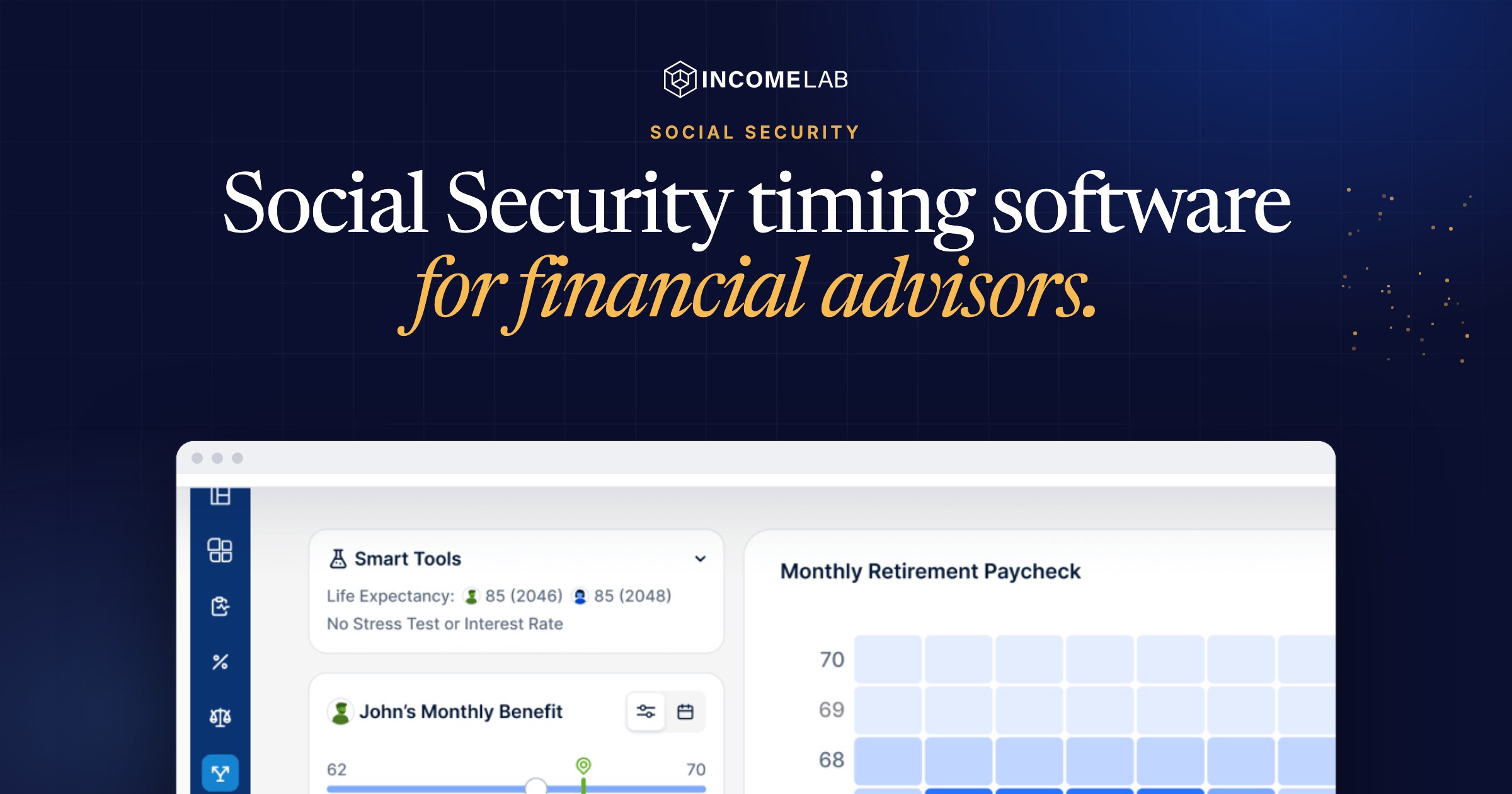
The three shapes of Social Security software
All Social Security planning software can handle how benefit amounts change if someone claims early, at full retirement age, or delays until age 70. The important differences emerge in how each tool handles the bigger picture, including how things change depending on mortality, policy changes, and how claiming affects the overall financial plan.
Standalone claiming calculators take a few inputs and answer the claiming question on its own terms, without looking to other parts of the clients’ financial situation. Covisum’s Social Security Timing produces optimal claiming ages, side-by-side strategy comparisons, a break-even chart, benefit-cut modeling, and client-ready reports, priced per advisor. Maximize My Social Security, from Laurence Kotlikoff’s Economic Security Planning, works household by household across own, spousal, divorced, survivor, and child benefits, with benefit-cut scenarios and updates for the Social Security Fairness Act, and publishes both a household edition and an advisor edition. T. Rowe Price distributes SSAnalyzer to financial intermediaries; according to its overview page, it builds unlimited custom strategies, compares any two side by side, handles widowed, divorced, and still-working scenarios, and runs a spending-gap analysis against Social Security income. Horsesmouth’s Savvy Social Security Planning is a year-long advisor program that bundles claiming software and an audit tool with client presentations, continuing education, and a report library. These tools are precise about the benefit rules, and that is their whole job.
Suite modules live inside broad planning platforms. According to its help center, RightCapital’s optimization tool evaluates over 700 filing strategies, incorporating spousal and survivor benefits, child benefits, family maximums, and earnings test adjustments, with break-even analysis and a configurable discount rate. Envestnet MoneyGuide names Social Security Optimization as a feature; its public pages publish no further claiming detail.
Plan-integrated claiming analysis uses the household’s Social Security decisions alongside its financial plan. Income Lab’s optimizer evaluates claiming dates for both spouses and coordinates eligible own, spousal and survivor benefits. For a surviving spouse, it can evaluate taking an own benefit while delaying the survivor claim, potentially until survivor full retirement age, so that the survivor benefit can increase. Its planning context also makes work and earnings assumptions available for the earnings test and related benefit adjustments without requiring the advisor to rebuild those inputs in another calculator. Advisors can explore mortality and longevity scenarios, benefit reductions, opportunity cost, and the effect of claiming on portfolio balances and retirement spending. Social Security Optimizer · Social Security claiming strategy guide
Advisor takeaway
The most useful analysis shows the financial significance of the claiming choice. Sometimes one strategy has a clear advantage; in other cases several claiming dates lead to similar spending outcomes. Advisors should be able to explain both results.
Six criteria that decide the choice
These six questions are useful when evaluating Social Security software. The key differences are the flexibility of the analysis and how much of the household’s financial situation can be brought into it.
-
Joint optimization. Does it optimize the household’s interacting benefits rather than treating each person separately? Check how it handles spousal and survivor benefits, including the option to receive an own benefit while delaying survivor benefits until survivor full retirement age. Income Lab evaluates more than 9,000 claiming combinations for a couple, with additional survivor-claim timing analysis and optimization. Many tools offer some sort of lifetime benefits heatmap. Some include all 9,000+ options for a couple and others limit to an annual sampling of claim dates. Given today’s computing power, most advisors and clients expect the complete picture.
-
Mortality and longevity. Can the advisor quickly explore different lifespans for either spouse, including early death and unusually long life? Mortality and longevity assumptions can materially change the preferred claim dates. Income Lab makes these scenarios part of the comparison instead of forcing a single life-expectancy assumption.
-
Taxation of benefits, year by year. Does the tool model benefit taxation with the rest of the household’s income year by year? Income Lab’s Tax Lab and taxation modules use the tax and income information already in the plan, allowing claiming choices to be evaluated alongside other sources of taxable income.
-
Work and the earnings test. Continuing to earn after taking Social Security before full retirement age can lead to benefit withholding. The rules are complex and depend on monthly timing of earnings. The best tools handle these calculations and projections seamlessly. Since Income Lab already models employment and earnings in the plan, those inputs carry into the claiming analysis with less separate data entry.
-
Policy rules and uncertainty. Can the advisor test future benefit reductions and other policy assumptions without rebuilding the analysis? Software must also reflect current claiming rules, including changes made by the Bipartisan Budget Act of 2015. Income Lab lets advisors explore the effect of a future benefit reduction on the relative appeal of different claiming dates.
-
Opportunity cost, portfolio effects and spending. Does the analysis quantify the cost of waiting for benefits, show how different claiming dates change portfolio balances, and connect those results to sustainable spending? Many tools, including Income Lab, include an opportunity cost or discount rate option. Income Lab extends this to allow advisors to assess the claiming decision in the context of “What can I spend?” Its retirement paycheck heatmap goes beyond total lifetime benefits to look at how different options affect (or don’t) overall spending. Income Lab’s stress testing tool also allows advisors to show clients the cost to the portfolio of delayed claiming. This is very often overlooked when focusing only on lifetime benefits.
The landscape
| Tool | Shape | What it does (per its own site; fetched September 23, re-verified September 30, 2026) | Published price |
|---|---|---|---|
| Covisum Social Security Timing | Standalone calculator | Optimal claiming ages, side-by-side strategies, break-even chart, benefit-cut modeling, client-ready reports, prospecting tools | $49.99 a month per advisor; associate licenses $39.99 per additional user a month; 10-day trial |
| Maximize My Social Security | Standalone calculator (household and advisor editions) | Own, spousal, divorced, survivor, and child benefits; earnings test and family maximum; benefit-cut scenarios; Social Security Fairness Act and Bipartisan Budget Act compliance; longevity scenarios | Household $49 a year Standard, $289 a year Standard Plus; advisor edition $349 a year, up to 100 clients per license |
| T. Rowe Price SSAnalyzer | Standalone calculator, distributed to financial intermediaries | Unlimited custom strategies, side-by-side comparison, widowed/divorced/still-working scenarios, spending-gap analysis, several life-expectancy outlooks, taxes/COLA/inflation impact, client-ready reports | Not published |
| Horsesmouth Savvy Social Security Planning | Advisor program with bundled software | Claiming software and audit tool; maximization, break-even, coordinated spousal, survivor, WEP/GPO, and divorce reports; client presentations and 12 CE credits | $697 for the year-long program |
| RightCapital (suite module) | Module inside a broad platform | Over 700 filing strategies; spousal, survivor, and child benefits; family maximums; earnings test adjustments; break-even; configurable discount rate | Suite pricing |
| Envestnet MoneyGuide (suite module) | Module inside a broad platform | Social Security Optimization is a named feature; its public pages publish no further claiming detail | Suite pricing; not published |
| Income Lab Social Security Optimizer | Plan-integrated, also sold standalone | More than 9,000 couples’ claiming combinations; survivor-claim timing optimization; five benefit-estimation methods; mortality and longevity scenarios; opportunity-cost and portfolio-balance comparisons; earnings-test and benefit-cut analysis; integrated retirement plan context | Standalone $600 a year per person, or $65 a month billed monthly; included in Income Lab, Core Suite $1,990 a year or $199 a month billed monthly, Pro Suite $2,990 a year or $299 a month billed monthly |
Because the names of these options are so similar, some clarification is needed: “Social Security Timing” is offered by Covisum, while “Social Security Solutions” and “SSAnalyzer” are separate brands, both of which direct advisors to T. Rowe Price pages.
Where the specialists are the better choice
The standalone calculators are the better choice in three specific situations.
Specialist software can be useful for complicated benefit histories, particularly cases involving retroactive benefit corrections or old public-pension rules. The Social Security Fairness Act repealed the Windfall Elimination Provision (WEP) and Government Pension Offset (GPO) for benefits payable beginning in January 2024, but earlier periods can still require careful review. Income Lab uses manual income entry for certain legacy cases, so practices with a high volume of these legacy situations may benefit from a separate specialist tool.
If Social Security advice is a standalone service, priced and delivered on its own, the specialist price points fit the deliverable: Maximize My Social Security’s advisor edition is $349 a year, Covisum’s Social Security Timing is $49.99 a month with a 10-day trial, and Horsesmouth’s $697 program adds the client-education machinery around the software. Income Lab’s own Optimizer is also sold standalone at $600 a year per person for exactly this kind of practice.
If the household is consumer-driven, Maximize My Social Security’s $49-a-year household edition serves the do-it-yourself claimer directly; that is a different buyer than this page’s reader.
What different claiming dates mean for the financial plan
Clients considering when to claim Social Security often want to explore uncertain assumptions. What happens if one spouse dies early, or both live into their nineties? What if future benefits are reduced? How much of the portfolio is used to support spending while benefits are delayed? Income Lab lets advisors explore these questions in the context of the full plan, where the central measure of a decision’s importance is its effect on the household’s ability to spend.
Claiming at 62, full retirement age or 70 changes both lifetime benefits and the withdrawals required from investments. Income Lab compares claiming dates alongside mortality and longevity assumptions, opportunity cost, and portfolio balances. The income, taxes, work and earnings assumptions are already part of the plan. For couples, the analysis also addresses coordinated benefits and survivor timing, including continuing an own benefit while deferring survivor benefits until survivor full retirement age when advantageous. methodology · walkthrough
The claiming heatmap adds perspective to the optimization result. It shows how much the outcomes differ across claiming combinations, so an advisor can distinguish a meaningful improvement from a negligible one. If several choices have almost the same effect on sustainable spending, the client has room to prioritize simplicity, comfort with risk or the timing of income. Finding a near-tie is itself a useful planning result.
Policy uncertainty is another reason to test more than one scenario. The 2026 Social Security Trustees Report projects that the Old-Age and Survivors Insurance trust fund will exhaust reserves in the fourth quarter of 2032, when continuing income would cover about 78% of scheduled benefits. The hypothetical combined OASI and Disability Insurance funds are projected to reach depletion in 2034, with approximately 83% payable from continuing income, absent legislative changes. These are projections, not announced benefit cuts. Income Lab allows advisors to apply a hypothetical future benefit reduction and compare its effects on claiming decisions.
Advisor takeaway
Test longevity assumptions and possible benefit changes, then examine how the claiming alternatives affect portfolio balances and sustainable spending. Use the heatmap to show whether the differences are large enough to warrant a strong recommendation or small enough to leave room for client preferences.
How different advisors use the analysis
Scenario A: a practice offering standalone Social Security advice. An advisor who runs claiming workshops and prepares dedicated reports may value specialist tools with benefit audits, client handouts and support for unusual historical records. Income Lab also offers its optimizer separately from the broader financial planning platform.
Scenario B: a retirement planning practice. A two-advisor firm serving households approaching retirement uses claiming analysis during discussions about work, investment withdrawals, taxes and sustainable spending. The advisor can adjust each spouse’s life expectancy, test a possible benefit reduction and consider delayed survivor claiming. The heatmap shows whether the alternatives produce materially different results, while the plan shows the effect on portfolio balances and “What can I spend?” Most of the household information is already available without re-entry.
Pricing
Income Lab publishes list pricing. Its Social Security Optimizer is available two ways: standalone at $600 a year per person, or $65 a month billed monthly, or as part of the platform, where Core is $1,990 a year ($199 a month billed monthly) and Pro is $2,990 a year ($299 a month billed monthly). Every platform trial is a free 14-day trial with full Pro access.
Among the specialists, according to their own sites: Covisum’s Social Security Timing is $49.99 a month per advisor with associate licenses at $39.99 per additional user a month and a 10-day trial. Maximize My Social Security publishes household pricing at $49 a year Standard and $289 a year Standard Plus, and an advisor edition at $349 a year covering up to 100 clients per license. Horsesmouth’s Savvy Social Security Planning program is $697 for the year. T. Rowe Price does not publish SSAnalyzer pricing. Modules that are available only as part of a broader planning product are priced with their suites.
Frequently asked questions
What software should an advisor use for Social Security timing?
For standalone claiming reports, dedicated benefit calculators may be sufficient. For clients using Social Security as part of a broader income plan, assess how the tools handle mortality, longevity, policy uncertainty, opportunity cost, portfolio balances and sustainable spending. A heatmap that exposes near-equivalent outcomes can be more useful than those that highlight only the top-ranked strategy.
Does Income Lab optimize claiming for couples?
Yes. Income Lab evaluates claiming combinations for couples, including the interaction of own and spousal benefits. It also optimizes survivor claim timing, including scenarios in which a surviving spouse continues receiving an own benefit and delays the survivor benefit until a later age, potentially survivor full retirement age. The optimizer provides benefit-estimation methods and comparisons of break-even, opportunity cost and broader planning outcomes.
Can these tools model a future Social Security benefit cut?
Yes. Income Lab supports hypothetical future benefit reductions, and some specialist tools offer similar scenarios. For perspective, the 2026 Trustees Report projects that OASI reserves will be depleted in the fourth quarter of 2032, when continuing income is projected to cover about 78% of scheduled benefits unless the law changes. Advisors can use reductions as scenarios rather than treating the projection as a certain outcome. Timing and size of future cuts modeled can be fully customized.
What about clients with public pensions?
The Social Security Fairness Act repealed the Windfall Elimination Provision and the Government Pension Offset for benefits payable from January 2024 onward. Earlier benefit periods and record corrections still carry the old rules, and that history work is specialist terrain; Horsesmouth’s program includes a dedicated WEP/GPO report. For those legacy scenarios Income Lab uses manual income entry rather than a built-in calculation, and a public-sector-heavy practice should weigh a dedicated tool alongside the plan if you still have clients who are affected.
Why does the claiming answer change inside a full plan?
Different claiming dates change benefit income and the portfolio withdrawals needed in the intervening years. Income Lab connects those effects to investment balances and the plan’s sustainable spending answer, “What can I spend?” The heatmap helps advisors tell whether the difference between claiming choices is substantial or relatively small. When outcomes are close, clients can make a comfortable choice without feeling that a small deviation from the mathematically highest-ranked option threatens the plan. Income Lab’s stress testing tool also puts claiming decisions into the portfolio context: could delayed claiming suppress portfolio balances more than the client would be comfortable with?
Sources
-
T3/Inside Information Advisor Software Surveys, 2024, 2025, and 2026 editions. According to the 2026 survey, Income Lab’s Social Security module is rated 8.60 and Horsesmouth Savvy Social Security 8.59; Income Lab is #1 by market share in retirement distribution planning, three years running (2024 to 2026).
-
Covisum, Social Security Timing and pricing, fetched September 23, 2026. Source for the price, associate licenses, trial, and capability list.
-
Economic Security Planning, Maximize My Social Security, pricing, and advisors pages, fetched September 23, 2026. Source for household and advisor pricing, benefit and rule coverage, benefit-cut scenarios, and the compliance statements.
-
T. Rowe Price, SSAnalyzer overview, fetched September 23, 2026. Source for the SSAnalyzer capability list; no pricing is published there.
-
Horsesmouth, Savvy Social Security Planning, fetched September 23, 2026. Source for the $697 program price, the bundled software, and the report list including the WEP/GPO report.
-
RightCapital, features and its help center’s Social Security optimization article, fetched September 23, 2026. Source for the module’s published capabilities and the over-700 strategy count.
-
Social Security Administration, 2026 Trustees Report summary, retrieved September 30, 2026. Source for the OASI fourth-quarter-2032 depletion projection and the approximately 78% coverage figure, and for the hypothetical combined-fund 2034/83% figures.
-
Income Lab, Social Security Optimizer, pricing, standalone Optimizer pricing, and Help Center documentation for the optimizer, benefit estimation, earnings tests, opportunity-cost analysis, and survivor benefits. Updated survivor-claim optimization capability described by Income Lab for this revision. Social Security Optimizer · pricing
All trademarks are property of their respective owners.

Ready to see this in action?
Watch how Income Lab helps advisors answer clients' toughest retirement income questions with guardrails-based planning.
Book a Walkthrough Start Free Trial